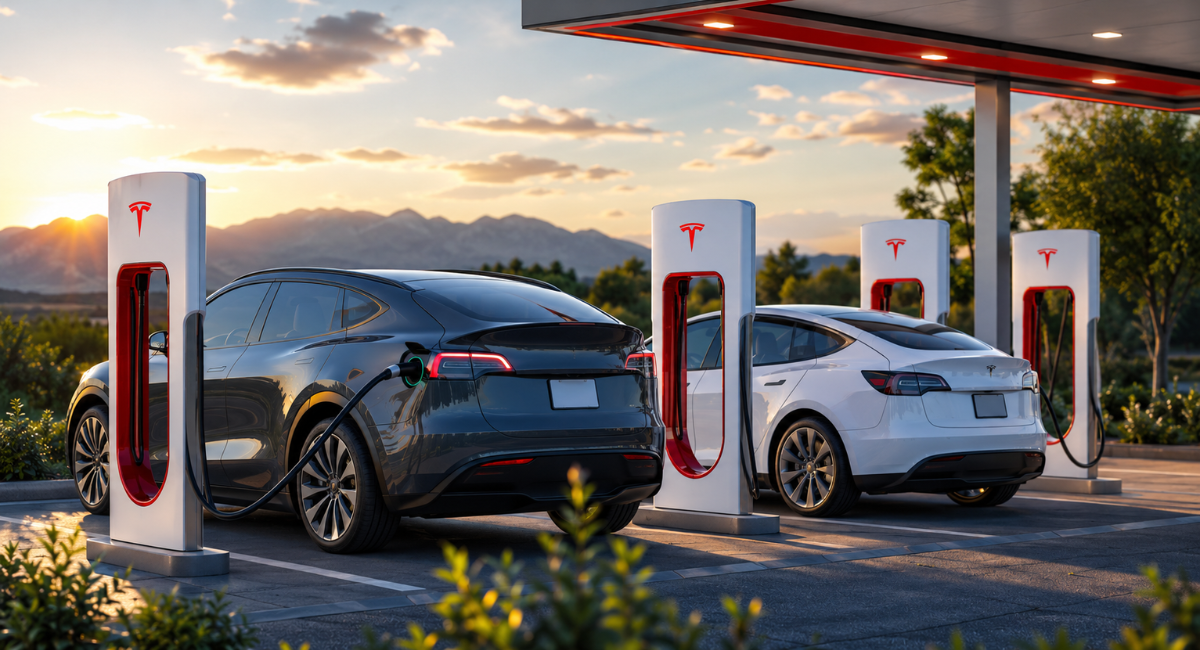
A non-Tesla EV plugging into a Supercharger pays roughly 40 percent more per kilowatt-hour than a Tesla does at the same stall, by Tesla’s own published pricing structure. A $12.99 monthly membership erases that gap entirely, matching Tesla owner pricing for any driver willing to pay it. Whether that membership actually saves money depends entirely on how often a driver Superchargers each month.
How The Pricing Gap Actually Works
Tesla vehicles pay a lower default rate at every Supercharger, while non-Tesla EVs using NACS or a CCS1 adapter pay a higher default rate at the same stall, a structural difference Tesla has confirmed averages roughly 40 percent.
That two-tier system applies uniformly across the network’s roughly 3,244 tracked stations, though the exact dollar gap swings by location and time of day rather than staying fixed nationwide.
What The $12.99 Membership Actually Buys
A Supercharging Membership, priced at $12.99 a month, drops a non-Tesla driver’s per-kilowatt-hour rate to match what Tesla owners pay automatically, with no separate membership required for Tesla vehicles themselves.
One membership covers all vehicles linked to a single account. A driver who owns both a Tesla and a non-Tesla EV needs only one membership to Supercharge the non-Tesla vehicle at Tesla-owner pricing.
Technician’s Note: Calculate the membership’s break-even point before subscribing. At current rate gaps, the $12.99 monthly fee pays for itself past roughly 66 kilowatt-hours of Supercharging in a month, equivalent to one or two typical road-trip charging stops.
Why The Rate Itself Varies So Much By Location
The standard, non-member rate averaged $0.632 per kilowatt-hour nationally as of a recent monthly tracking period, though Hawaii ran as high as $0.84 per kilowatt-hour while Nebraska stayed near $0.39.
Member pricing tracks a consistent discount relative to the standard rate rather than a fixed dollar amount, running roughly 31 percent below standard pricing, or about $0.196 per kilowatt-hour less, through that same tracked period.
Deciding Whether The Membership Makes Sense
A driver who Supercharges occasionally, mainly on rare road trips, likely spends less overall paying the higher per-session rate than committing to a $12.99 monthly fee that goes unused most months.
A driver who Superchargers regularly, four or more times monthly according to several current pricing guides, typically recoups the membership fee quickly and continues saving on every session afterward.
Common Questions About Non-Tesla Supercharger Pricing
How much more do non-Tesla EVs pay at Superchargers than Tesla vehicles?
Roughly 40 percent more on average by Tesla’s own published pricing structure, though the exact gap varies by location and time of day across the network’s approximately 3,244 tracked stations.
What does Tesla’s $12.99 Supercharging Membership actually do?
It drops a non-Tesla driver’s per-kilowatt-hour rate to match Tesla-owner pricing automatically. One membership covers every vehicle linked to a single Tesla account, including a non-Tesla EV.
At what point does the Supercharging Membership actually pay for itself?
At current rate gaps, the $12.99 monthly fee breaks even past roughly 66 kilowatt-hours of Supercharging in a month, equivalent to one or two typical road-trip charging stops.