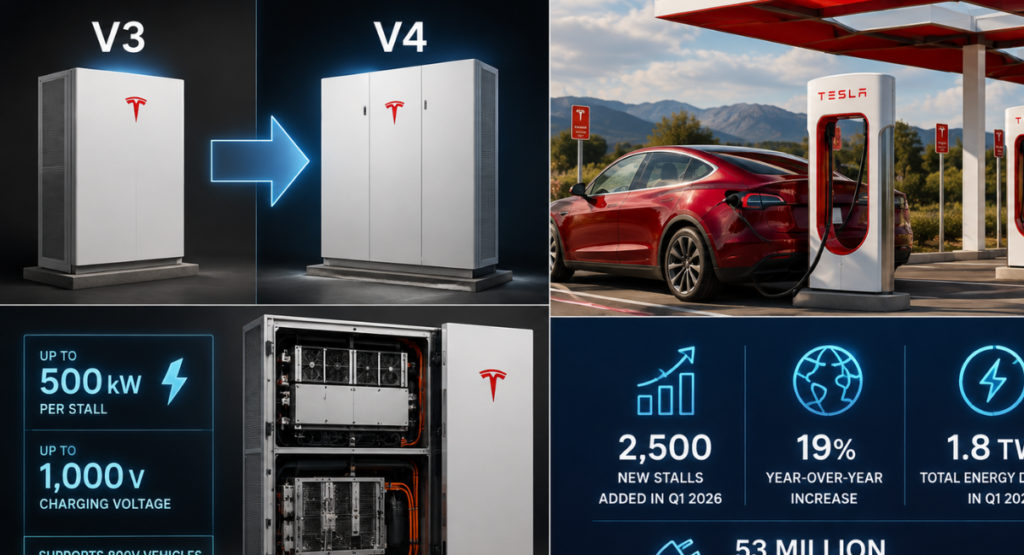
Tesla’s Gigafactory New York produced its final V3 Supercharger cabinet on March 16, 2026, closing out a seven-year, 15,000-cabinet production run. The V4 cabinet line has taken over entirely, bringing 500-kilowatt charging capability and support for 800-volt vehicles. That hardware shift affects far more than peak charging speed, reshaping installation costs and expansion pace across the entire network.
What Actually Ended, And What Replaced It
Tesla confirmed on March 16, 2026 that Gigafactory New York had built its final V3 Supercharger cabinet, ending a production run spanning seven years and roughly 15,000 total cabinets installed across the network.
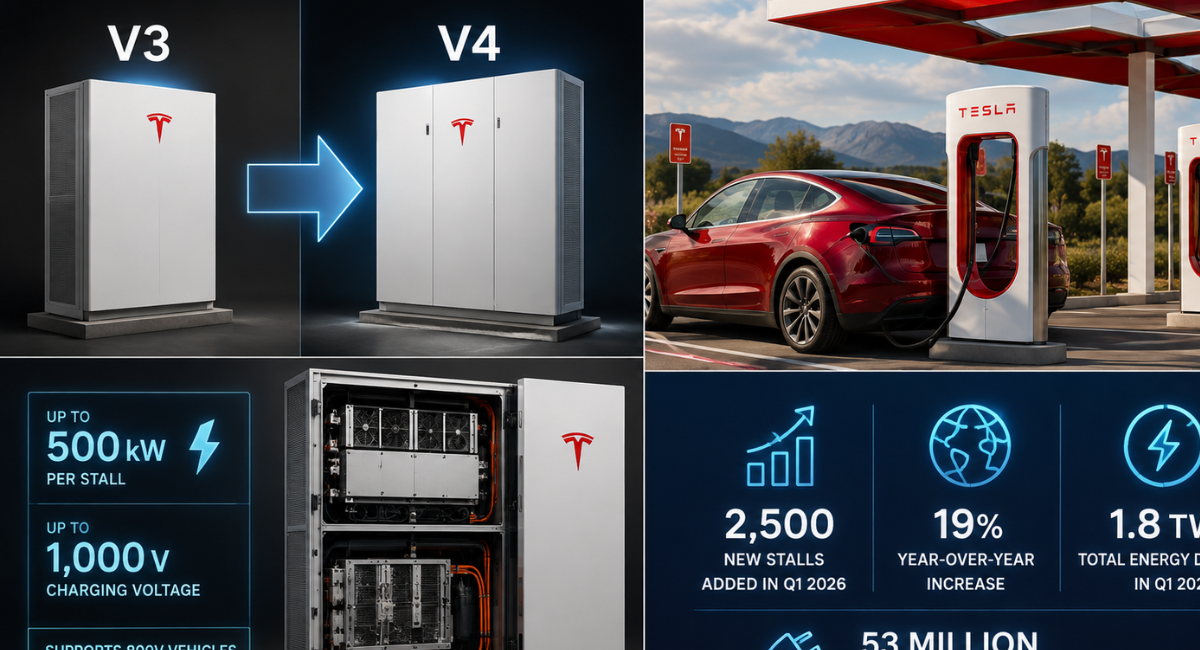
The V4 cabinet line now handles all new production, delivering up to 500 kilowatts per stall through two power electronics cabinets, each capable of supplying up to eight V4 dispensers at 1.2 megawatts total output.
Why 800-Volt Support Matters Beyond Peak Speed
V4 hardware supports charging voltages up to 1,000 volts, a genuine upgrade over V3’s more limited voltage range, allowing newer 800-volt vehicles to actually reach their designed peak charging rate at a Supercharger for the first time.
A vehicle built for 800-volt fast charging previously had to step down its charging rate at a V3 stall, regardless of the vehicle’s own capability, since the cabinet itself capped the deliverable voltage below what the car could accept.
Technician’s Note: Check whether a specific charging stop uses genuine V4 hardware or older V3 equipment still operating at existing sites. Tesla’s rollout is gradual, and a station’s cabinet generation directly determines the maximum charging speed available there.
What This Means For Network Expansion Pace
V4’s simplified installation process reduces both capital cost and deployment time per site, a factor Tesla has cited as accelerating rollout specifically in underserved regions with less existing charging infrastructure.
Tesla added roughly 2,500 new Supercharger stalls globally in the first quarter of 2026 alone, a 19 percent year-over-year increase, with total network capacity reaching 1.8 terawatt-hours delivered across 53 million individual charging sessions that quarter.
What A Driver Should Actually Expect At A V4 Station
Not every current Supercharger location has been upgraded to V4 hardware yet, since the transition applies to new cabinet production going forward rather than an immediate retrofit of every existing V3 site.
A driver specifically chasing maximum charging speed on an 800-volt vehicle should verify a target station’s hardware generation before counting on the full 500-kilowatt rate, since older V3 sites remain common across much of the existing network.
Common Questions About The V3-to-V4 Supercharger Transition
Is Tesla still building V3 Supercharger cabinets?
No. Gigafactory New York produced its final V3 cabinet on March 16, 2026, ending a seven-year, roughly 15,000-cabinet production run. All new Supercharger cabinet production now uses the V4 design.
What’s the actual charging speed difference between V3 and V4 Superchargers?
V4 delivers up to 500 kilowatts per stall and supports charging voltages up to 1,000 volts, letting newer 800-volt vehicles reach their designed peak rate, something V3’s more limited voltage range often prevented.
How much has Tesla’s Supercharger network grown since the V4 transition began?
Tesla added roughly 2,500 new Supercharger stalls globally in Q1 2026 alone, a 19 percent year-over-year increase, with total network capacity reaching 1.8 terawatt-hours delivered that quarter.
Related Reading
- Non-Tesla Drivers Pay Up To 40% More At Superchargers
- One Charging Network Just Hit A 9.41-Out-Of-10 Reliability Score
- 350kW Ultra-Fast Charging Is Coming — What Bentley’s 6.5-Minute Claim Means
\