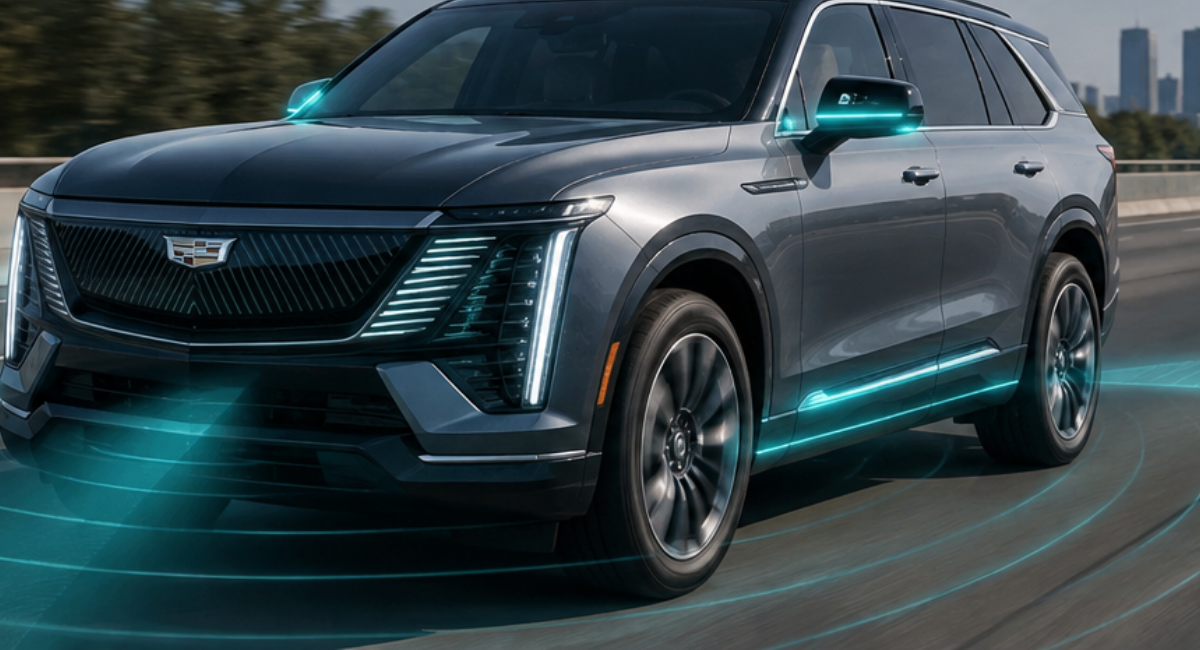
GM’s 2028 eyes-off system and today’s hands-free Super Cruise sound like a small step apart. The engineering gap between them is much larger than the marketing language suggests. Removing the requirement to watch the road shifts legal and technical responsibility for driving decisions from the driver to the vehicle, a jump that requires an entirely different sensor and software architecture underneath.
Why ‘Hands-Free’ And ‘Eyes-Off’ Aren’t A Small Step Apart
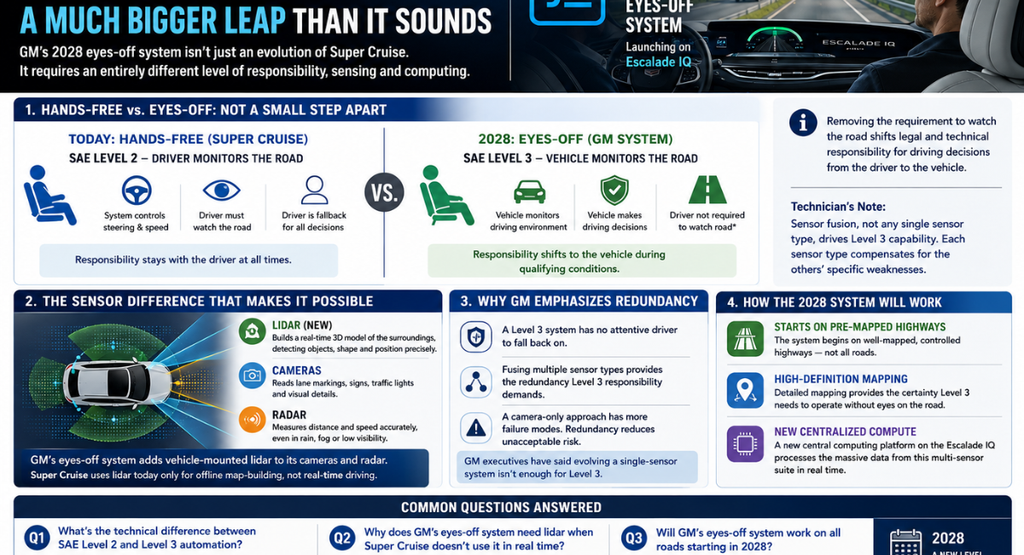
Today’s Super Cruise, and similar systems from other automakers, qualify as SAE Level 2 automation, where the driver remains the fallback for every driving decision even while the system handles steering and speed.
GM’s planned eyes-off system qualifies as SAE Level 3 conditional automation, where the vehicle itself becomes responsible for monitoring the driving environment during qualifying conditions, a fundamentally different liability and safety structure.
The Sensor Difference That Makes This Possible
GM’s eyes-off system adds vehicle-mounted lidar to its existing camera and radar suite, a sensor type Super Cruise currently uses only for offline map-building rather than real-time, onboard perception.
Lidar builds a three-dimensional model of the vehicle’s surroundings in real time, complementing cameras, which read lane markings and signs well, and radar, which tracks distance and closing speed accurately in poor visibility.
Technician’s Note: Sensor fusion, not any single sensor type, drives Level 3 capability. A system relying on cameras alone faces different failure modes than one combining lidar, radar, and cameras, since each sensor type compensates for the others’ specific weaknesses.
Why GM Emphasizes Redundancy Over A Single Sensor Type
GM executives have specifically criticized a camera-only approach for Level 3 automation, arguing that fusing multiple sensor types, rather than evolving a single-sensor system incrementally, provides the redundancy Level 3 responsibility actually demands.
That redundancy matters because a Level 3 system must independently detect and respond to conditions a Level 2 system can simply hand back to an already-watching driver. Removing that human backup raises the bar for what the sensor suite alone must catch.
What This Means For How The 2028 System Will Actually Work
GM has stated the eyes-off system will begin specifically on pre-mapped highways, not all roads immediately, reflecting the additional certainty a controlled, well-mapped environment provides a Level 3 system versus unpredictable surface streets.
A new centralized computing platform, also launching on the Escalade IQ in 2028, will support the increased sensor data processing this multi-sensor approach requires beyond what Super Cruise’s current architecture handles.
Common Questions About Eyes-Off Vs. Hands-Free Driving
What’s the technical difference between SAE Level 2 and Level 3 automation?
Level 2 systems, like current Super Cruise, keep the driver as the fallback for every driving decision. Level 3 systems shift monitoring responsibility to the vehicle itself during qualifying conditions, requiring a fundamentally more capable sensor and software architecture.
Why does GM’s eyes-off system need lidar when current Super Cruise doesn’t use it in real time?
Lidar builds a real-time three-dimensional model of the vehicle’s surroundings, a capability Level 3 automation requires since the vehicle, not an attentive driver, must independently detect and respond to road conditions.
Will GM’s eyes-off system work on all roads starting in 2028?
No. GM has stated the system will begin specifically with pre-mapped highways, reflecting the additional certainty a controlled, well-understood environment provides compared to unpredictable surface streets.