


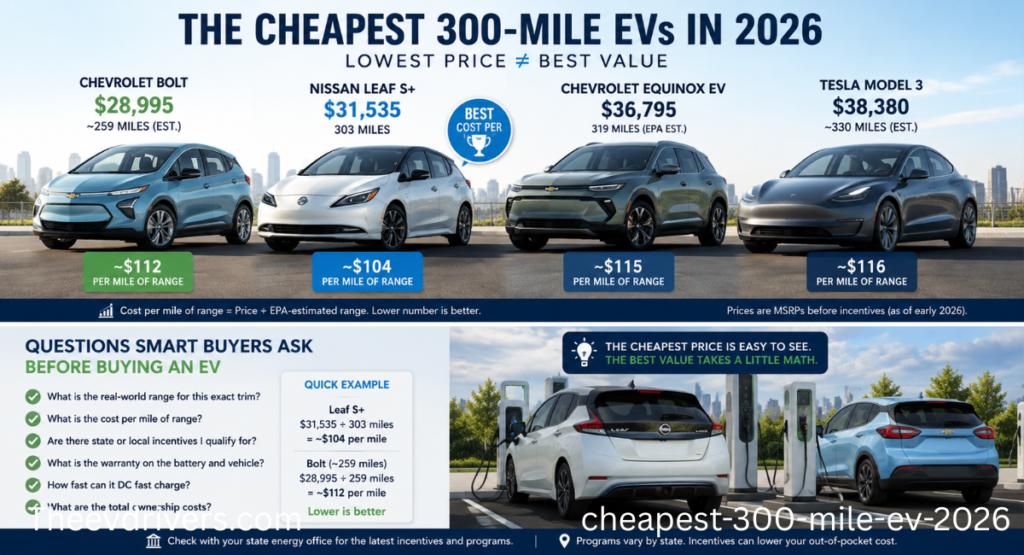
Cheapest-EV roundups keep leading with the Chevrolet Bolt at $28,995. That price wins on sticker alone. The Nissan Leaf S+ trim costs $31,535 and delivers 303 miles of range. Divide price by range and the Leaf actually wins on cost per mile. Most guides never run that math. A $2,540 gap buys 44 more miles than the Bolt offers.
Why Sticker Price Alone Misleads Shoppers
Ranking EVs by starting MSRP alone rewards the cheapest number, not the best value. A shopper comparing only price tags picks the Bolt every time. That ranking ignores what each dollar actually buys in usable range.
Cost per mile of range tells a fuller story. The Bolt’s exact range varies by trim, but its price advantage shrinks once range enters the equation. The Leaf’s 303-mile figure applies specifically to its S+ trim, not the base version.
Running The Real Cost-Per-Mile Math
Dividing $31,535 by 303 miles puts the Leaf S+ at roughly $104 per mile of range. A lower-range Bolt trim near $28,995 with roughly 259 miles lands closer to $112 per mile. The gap is not large, but it flips the assumed winner.
Range-per-dollar matters most for buyers doing longer commutes or fewer public charging stops. A driver doing short trips gains little from the extra range and may prefer the Bolt’s lower entry price instead.
Technician’s Note: Confirm the exact trim before comparing range figures. Manufacturers often quote their best-case trim in marketing copy, not the entry-level version most buyers actually finance.
Where The Equinox EV And Model 3 Fit In
The Chevrolet Equinox EV starts at $36,795 with an EPA-estimated 319 miles, per manufacturer specifications. That works out to roughly $115 per mile, more than either budget option but with SUV cargo space neither hatchback offers.
The Tesla Model 3 starts at $38,380 with class-leading real-world efficiency. Its cost per mile of range sits close to the Equinox, though its charging network access remains broader across most regions.
What Changed The Math In 2026
New EV inventory reached roughly 130 days’ supply by early 2026, well above the 89-day average for gas vehicles, according to industry sales data. That surplus pushed automakers toward steeper discounting on exactly these budget trims.
State incentives still apply on top of these prices in many regions. Colorado offers up to $5,000 on qualifying EVs, and California’s Clean Vehicle Rebate Project remains active. Checking a state energy office before signing narrows the real out-of-pocket cost further.
Common Questions About The Cheapest 300-Mile EVs
Is the Chevrolet Bolt still the cheapest EV to buy in 2026?
Yes, on sticker price, starting at $28,995. On cost per mile of range, the Nissan Leaf S+ trim at $31,535 for 303 miles can work out cheaper per mile, depending on the exact Bolt trim compared.
Does the Nissan Leaf’s 303-mile range apply to every trim?
No. That figure applies specifically to the Leaf S+ trim. Lower Leaf trims carry less range, so shoppers should confirm the exact trim’s EPA rating before assuming the 303-mile figure applies.
Are state incentives still available after the federal EV tax credit ended?
Yes, in many states. Colorado, California, New York, Vermont, and Massachusetts all maintain active programs as of 2026. Checking a state energy office confirms current eligibility before finalizing any purchase.
Related Reading
- EV Deals Run Deeper Than The Sticker Price Suggests
- 46 EVs Now Claim 300+ Miles Of Range
- Sedan Vs. SUV EVs: Why Matching Range Numbers Hide A Real Efficiency Gap