

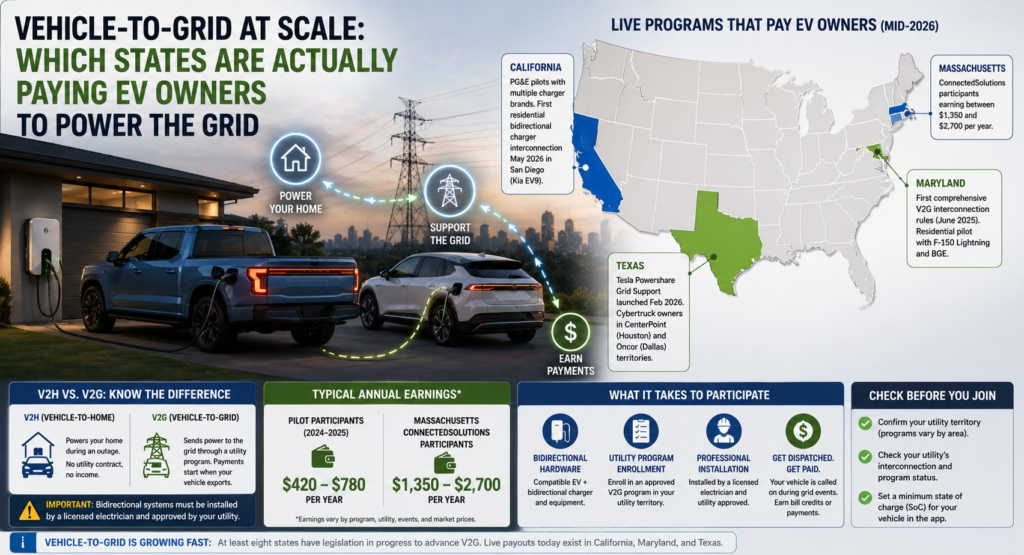
At least eight states are developing programs to export power from EVs and electric buses. That number keeps climbing through 2026. Live payouts now exist in California, Maryland, and Texas, not just pilot proposals. Massachusetts stands out further, with some participants earning over $1,300 a year. Most coverage still treats vehicle-to-grid as a future concept. The programs paying Ev owners today tell a different story.
Why “Eight States” Undersells What’s Already Live
Eight states have enacted or proposed legislation to advance vehicle-to-grid systems, including California, Maryland, Massachusetts, and New Jersey. Proposed legislation and an active payout are different things entirely. Fewer than ten residential programs actually exist nationwide as of mid-2026.
That gap between legislative interest and working payouts is the real story most coverage skips. A state appearing on a policy list does not guarantee a resident can enroll today. Checking a specific utility’s program status matters more than checking a state’s legislative status.
Where EV Owners Are Actually Getting Paid Today
Maryland adopted the nation’s first comprehensive V2G interconnection rules in June 2025. Sunrun and Baltimore Gas & Electric then launched a residential pilot using Ford F-150 Lightning trucks. That program linked dozens of households into one dispatchable power resource, marking the country’s first true residential V2G pilot.
Texas followed with Tesla’s Powershare Grid Support program, which launched in February 2026. It currently covers Cybertruck owners inside CenterPoint Energy’s Houston territory and Oncor’s Dallas territory. Eligibility requires installed Powershare hardware, so the program does not yet reach every Tesla owner statewide.
Technician’s Note: Confirm which utility service territory a home actually sits in before assuming eligibility. CenterPoint and Oncor cover different parts of Texas, and a program can be live in one zone while unavailable a few miles away.
What A Live Program Actually Pays
Payouts vary sharply by state and program structure. Pilot participants between 2024 and 2025 generally earned between $420 and $780 a year. Massachusetts stands apart, where ConnectedSolutions participants have cleared between $1,350 and $2,700 annually.
Texas payouts remain less predictable, since Tesla has not published typical earnings figures. Based on ERCOT peak-event pricing, participants can expect roughly $200 to $500 a year for typical participation. That range depends heavily on how often the grid calls for backup power during peak demand.
V2H, V2G, And The Difference That Determines Payment
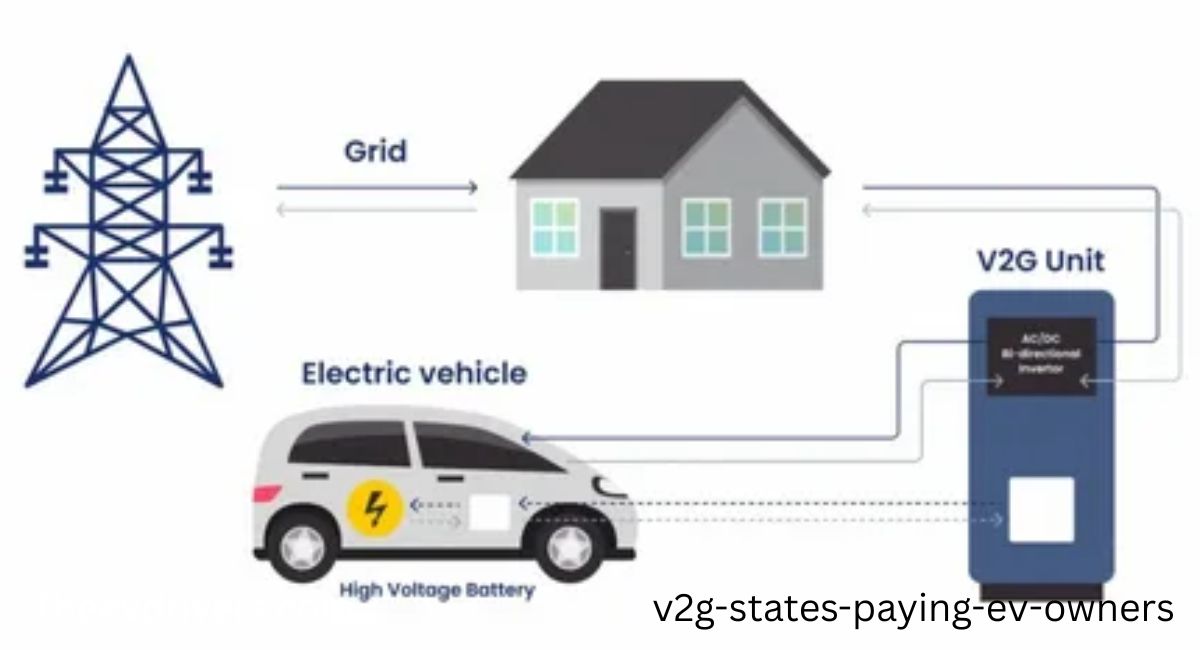
Vehicle-to-home, or V2H, lets a car power a house during an outage. That capability alone generates no income, since no utility contract sits behind it. Vehicle-to-grid, or V2G, adds that contract, and payment only flows once a vehicle actually exports power back to the grid.
A car marketed as “V2X capable” may only support V2H, not a paying V2G program. Any bidirectional hardware installation should go through a licensed electrician and the utility’s own interconnection process, since incorrect wiring on a system feeding power back to the grid creates a real shock and fire risk.
Checking Whether A Program Actually Applies
California carries the most mature V2G activity nationally, led by Pacific Gas and Electric’s pilots across several charger brands, including GM Energy’s bundle, the Wallbox Quasar 2, and Tesla’s Powershare setup. San Diego County saw the first residential bidirectional charger interconnection in May 2026, using a Kia EV9.
A resident outside California, Texas, or Massachusetts should not assume a similar program exists nearby. Checking a utility’s own interconnection page gives a more reliable answer than a national trend article. Legislative movement in a state signals future potential, not a program ready to join today.
Common Questions About Getting Paid For Vehicle-To-Grid
Which states currently have live programs paying EV owners for vehicle-to-grid participation?
California, Maryland, Massachusetts, and Texas currently run active programs, led by utilities like PG&E, Baltimore Gas & Electric, and Tesla’s Texas partners. Fewer than ten residential programs exist nationwide as of mid-2026, so availability still varies sharply by location.
Does having vehicle-to-home capability mean an EV owner can get paid through vehicle-to-grid?
No. Vehicle-to-home only powers a house during an outage, with no utility contract behind it. Vehicle-to-grid requires enrollment in an actual utility program, and payment only starts once a vehicle exports power through that contract.
How much can a typical EV owner earn from a live vehicle-to-grid program?
Earnings vary by state and program structure. Recent pilot participants generally earned $420 to $780 annually, while some Massachusetts ConnectedSolutions participants cleared $1,350 to $2,700 a year under more favorable local incentive terms.