





A June 2026 range-gap analysis compared over 1,600 EVs against their official ratings. WLTP-rated models in Europe averaged nearly 25 percent below their sticker figure. EPA-rated models in the US averaged closer to 10 percent below. Both ratings come from a controlled lab cycle, not a real commute. Most reviews still quote the number alone. Few say how much of it survives an actual drive.
How The WLTP Test Cycle Actually Runs
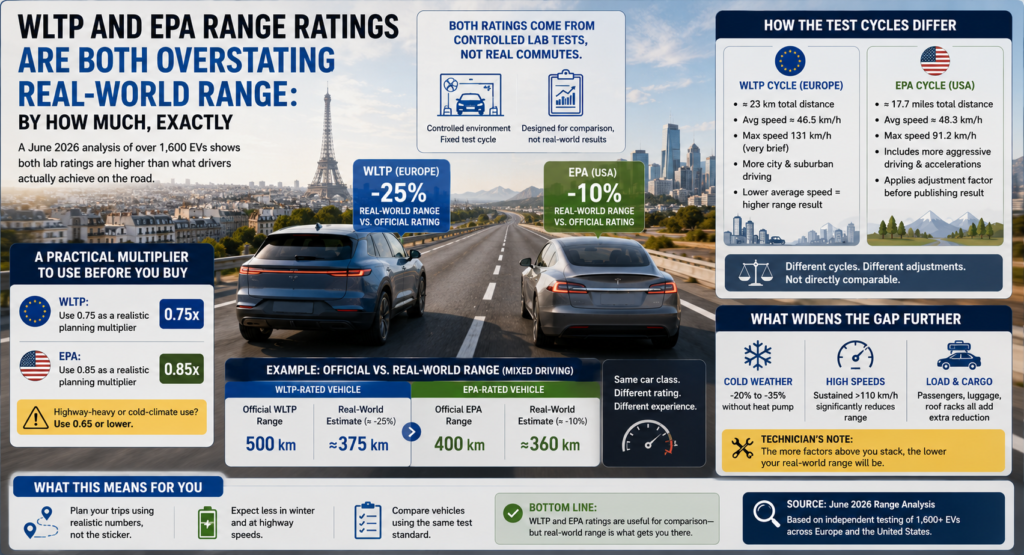
WLTP tests a vehicle across a fixed lab cycle covering roughly 23 kilometers, at an average speed near 46.5 kilometers per hour. Top speed during the cycle reaches 131 kilometers per hour only briefly.
That average speed sits well below typical highway cruising speeds in most countries. A test built around city and suburban driving patterns produces a rosier number than a driver doing mostly motorway miles.
Technician’s Note: Treat a WLTP figure as a mixed-driving estimate, not a highway promise. The gap widens specifically at sustained speeds above 110 kilometers per hour.
The Actual Gap Observed In Recent Testing
A June 2026 analysis of more than 1,600 comparable EVs found real-world range estimates averaging close to 25 percent below official WLTP figures in Europe.
The same analysis found real-world estimates averaging closer to 10 percent below official EPA figures in the US, a meaningfully smaller gap than Europe’s.
Independent press testing narrows that range further for specific conditions. At steady highway speeds in mild weather, testers commonly measure 15 to 18 percent below the EPA figure.
Why EPA And WLTP Diverge By Nearly Double
The EPA cycle already incorporates a real-world adjustment, applying a correction factor to raw laboratory results before publishing a final number.
WLTP publishes a more direct lab result, without an equivalent downward adjustment built into the published figure.
That structural difference explains why a WLTP number and an EPA number for the same car, translated into equal units, still don’t describe the same expected driving experience.
What Actually Widens The Gap Beyond The Baseline
Cold weather cuts range further on top of the baseline test-cycle gap, commonly by 20 to 35 percent without a heat pump running.
Sustained speeds above 110 kilometers per hour compound the gap again, since neither test cycle sustains that speed for long during its own measurement.
A loaded vehicle, whether carrying passengers, cargo, or a roof rack, adds a further reduction on top of both effects, though rating agencies rarely quantify that specific factor.
A Practical Multiplier Worth Using Before Buying
Applying a rough 0.85 multiplier to an EPA figure, and a 0.75 multiplier to a WLTP figure, produces a more realistic planning number for mixed driving.
Highway-heavy commutes, or cold-climate ownership, should shift that multiplier further down, closer to 0.65 for WLTP-rated vehicles used mostly on the motorway in winter.
Technician’s Note: Compare two vehicles using the same test standard whenever possible. An EPA figure and a WLTP figure for competing models are not directly comparable without converting both first.
Common Questions About WLTP And EPA Range Ratings
Is the WLTP rating simply wrong or misleading?
Not exactly. It measures a fixed lab cycle accurately, including its official 46.5 km/h average speed. The rating becomes misleading only when a reader assumes it predicts real driving, rather than one standardized test.
Why does the EPA gap run smaller than the WLTP gap?
The EPA figure already applies a downward adjustment to raw laboratory results before publication. WLTP publishes a more direct lab result, without an equivalent built-in correction, which is why its figure sits further from real driving.
What single number should a buyer use to estimate real range?
A rough 0.85 multiplier on an EPA figure, or 0.75 on a WLTP figure, gives a reasonable planning estimate for mixed driving. Highway-heavy or cold-climate use should push that multiplier lower still.