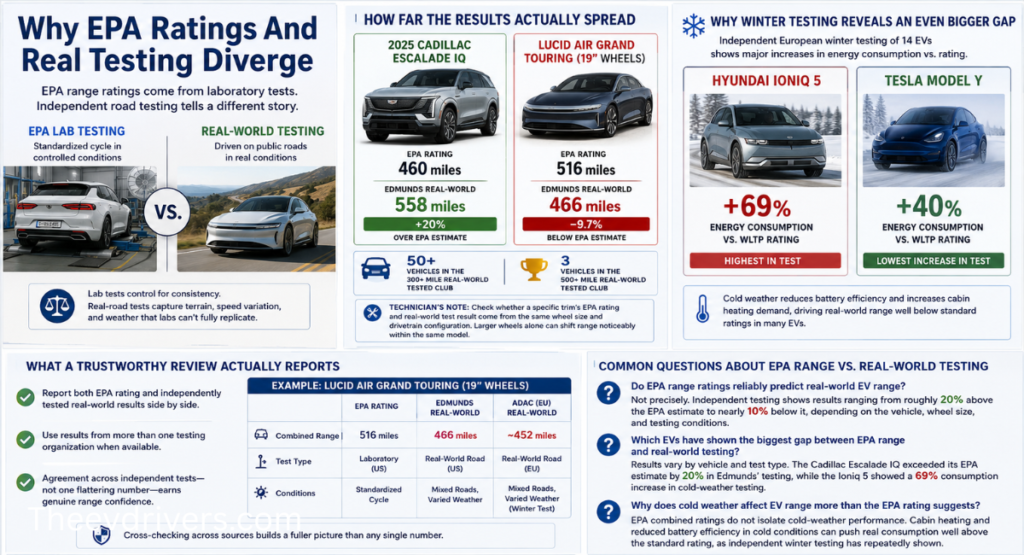
Every EV carries an EPA range rating built from a laboratory cycle, not a real commute. Independent testers drive the actual mileage instead. Edmunds’ own range tests show results swinging from 20 percent above EPA estimates to nearly 10 percent below them, depending on the vehicle. Most reviews still quote the EPA number alone, without flagging how far it can drift from real-world results.
Why EPA Ratings And Real Testing Diverge
The EPA derives its combined range rating from a laboratory-based process using a standardized driving cycle. Edmunds instead drives each vehicle on an actual public-road loop, designed as a real-world complement to that lab process.
Those two methods measure different things. A lab cycle controls for consistent conditions, while real-road testing captures actual terrain, speed variation, and weather that a lab cycle cannot fully replicate.
How Far The Results Actually Spread
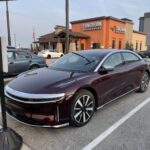
Edmunds’ testing carried the 2025 Cadillac Escalade IQ 558 miles against a 460-mile EPA estimate, a 20 percent overshoot. The Lucid Air Grand Touring on 19-inch wheels fell nearly 10 percent below its EPA figure in the opposite direction.
Edmunds now counts more than 50 vehicles in its 300-mile-plus real-world tested club, alongside three vehicles in a 500-mile-plus club. That spread shows the EPA number functions as a starting reference, not a guaranteed outcome.
Technician’s Note: Check whether a specific trim’s EPA rating and real-world test result come from the same wheel size and drivetrain configuration. Larger wheels alone can shift range noticeably within the same model.
Why Winter Testing Reveals An Even Bigger Gap
Independent European winter testing found the Hyundai Ioniq 5 lost the most range among 14 tested EVs, with energy consumption running 69 percent above its WLTP rating in cold conditions.
The Tesla Model Y posted the smallest winter consumption increase in that same test, at roughly 40 percent above its rating, still a significant real-world gap most reviews leave unmentioned outside dedicated winter-testing coverage.
What A Trustworthy Review Actually Reports
A useful review states both the EPA figure and an independently tested real-world result side by side, ideally drawn from more than one testing organization. Relying on a single source’s number leaves no way to catch an outlier result.
Cross-checking Edmunds against European testers like ADAC, when both cover the same model, builds a fuller picture than either source alone provides. Agreement across independent tests, not one flattering number, earns genuine range confidence.
Common Questions About EPA Range Vs. Real-World Testing
Do EPA range ratings reliably predict real-world EV range?
Not precisely. Independent testing shows results ranging from roughly 20 percent above the EPA estimate to nearly 10 percent below it, depending on the vehicle, wheel size, and testing conditions.
Which EVs have shown the biggest gap between EPA range and real-world testing?
Results vary by vehicle and test type. The Cadillac Escalade IQ exceeded its EPA estimate by 20 percent in Edmunds’ testing, while the Ioniq 5 showed a 69 percent consumption increase in cold-weather testing.
Why does cold weather affect EV range more than the EPA rating suggests?
EPA combined ratings do not isolate cold-weather performance. Cabin heating and reduced battery efficiency in cold conditions can push real consumption well above the standard rating, as independent winter testing has repeatedly shown.
Related Reading
- 46 EVs Now Claim 300+ Miles Of Range
- Cold Weather Cuts Into EV Range More Than Most Reviews Ever Test For
- WLTP And EPA Range Ratings Are Both Overstating Real-World Range