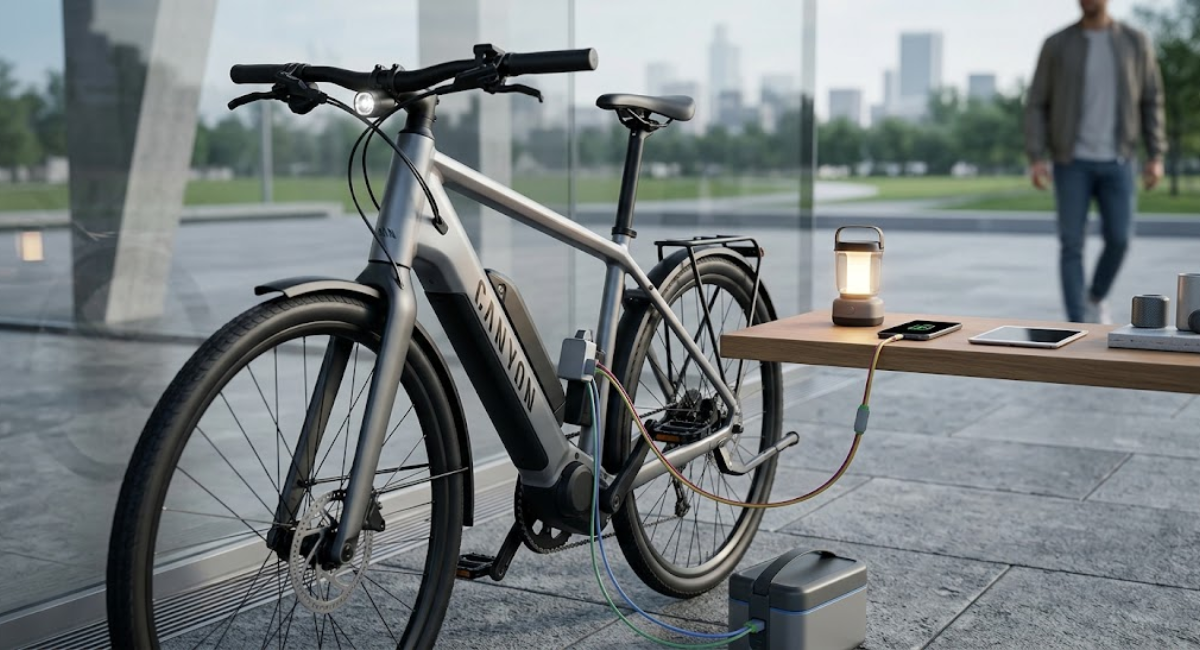
Vehicle-to-everything technology has mostly meant cars powering homes and grids until now. At Eurobike 2026 in Frankfurt, Canyon demonstrated how close a series-production e-bike with V2X capability actually is. That demonstration signals the same energy-sharing concept reshaping EV ownership is beginning to reach two-wheeled electric transportation, with a very different set of practical tradeoffs.
What Canyon Actually Showed At Eurobike
Canyon demonstrated V2X-capable e-bike technology at Eurobike 2026, held in Frankfurt am Main this September, showing how close a series-production model with that capability has come to reaching actual buyers rather than remaining a concept.
That demonstration places Canyon among a small group of manufacturers actively developing V2X capability specifically for e-bikes, a category where battery capacity runs dramatically smaller than any electric vehicle but still holds genuine usable energy.
How E-Bike V2X Differs From Car-Based V2X
An EV’s battery typically holds 60 to 100-plus kilowatt-hours, enough to meaningfully power a home during an outage. An e-bike battery holds a small fraction of that, typically under one kilowatt-hour, ruling out any comparable home-backup application.
That scale difference shifts e-bike V2X toward smaller, more targeted use cases: powering a phone or small device directly, feeding a compatible portable power station, or potentially supplementing a home’s power draw only briefly rather than sustaining it through an extended outage.
Technician’s Note: Confirm exactly what a V2X-capable e-bike can actually power before assuming a home-backup use case applies. A battery sized for pedal-assist propulsion holds a genuinely small energy reserve compared to any vehicle-scale bidirectional system.
Why This Capability Might Still Matter
E-bike commuters already carry a battery with them daily, a resource that currently just sits unused once a ride ends. V2X capability turns that already-owned battery into a small, portable power source without requiring any additional purchase.
For emergency preparedness specifically, a V2X-capable e-bike battery could supplement phone charging, small device power, or emergency lighting during a short outage, a genuinely useful capability even without matching a car’s home-backup scale.
What Still Separates A Demo From A Real Product
A Eurobike demonstration confirms the underlying technology works, not that Canyon has finalized pricing, a specific release date, or confirmed which markets will receive a V2X-capable model first.
The broader e-bike industry’s current financial instability, including Accell Group’s recent bankruptcy and multiple other manufacturer struggles, adds genuine uncertainty about how quickly any single company can bring a new capability like this from demonstration to shelf.
Common Questions About E-Bike V2X Technology
What did Canyon actually demonstrate at Eurobike 2026?
Canyon showed how close a series-production e-bike with vehicle-to-everything, or V2X, charging capability has come to reaching buyers, extending a technology previously associated mainly with electric vehicles to two-wheeled transportation.
Can a V2X-capable e-bike power a house like a bidirectional EV can?
No. An e-bike battery typically holds under one kilowatt-hour, a small fraction of an EV’s 60-to-100-plus kilowatt-hour capacity, limiting e-bike V2X to smaller applications like charging a phone or small device rather than home backup.
Is a V2X-capable e-bike available to buy yet?
Not based on Canyon’s Eurobike 2026 demonstration alone. A demonstration confirms the technology works, but Canyon has not confirmed final pricing, a release date, or which markets would receive the capability first.