






Summer road-trip season pushes more EVs onto interstate corridors than any other stretch of the year. Charging network comparisons usually rank stations by price per kilowatt-hour and top charging speed. Neither number predicts whether a stall actually works when a driver rolls up low on charge. Real uptime data does, and it is publicly available before departure, not after arrival.
The Number Every Speed Comparison Skips
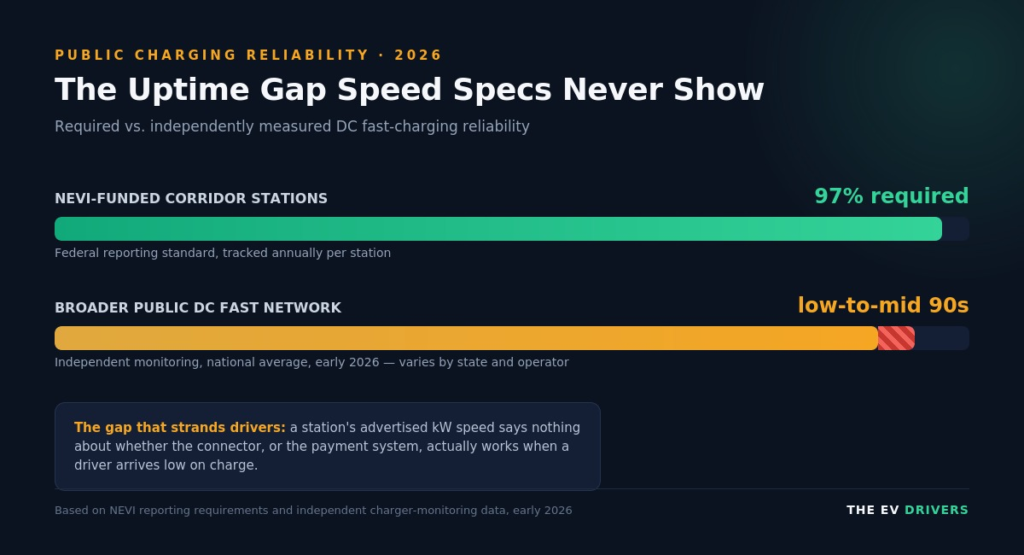
Federally funded charging sites must hit a 97% uptime standard, tracked through the NEVI program’s reporting tool. Independent monitoring of the broader public DC fast-charging network puts the national average reliability score in the low-to-mid 90s as of early 2026, with wide variation by state and operator. That gap between headline network claims and independently measured performance is where road trips go wrong.
A station rated for 150 kW charging speed is worthless if its connector is broken or its payment system is down. Speed specs describe a stall’s best-case output. Uptime data describes whether the stall works at all.
Where To Check Real-Time Reliability Before Leaving
Several public data sources track live charger status rather than advertised specs. State-level dashboards tied to NEVI compliance reporting show funded corridor stations and their recent uptime record. Independent monitoring platforms track a large share of the country’s fast chargers and publish uptime scores updated regularly, broken out by state and network.
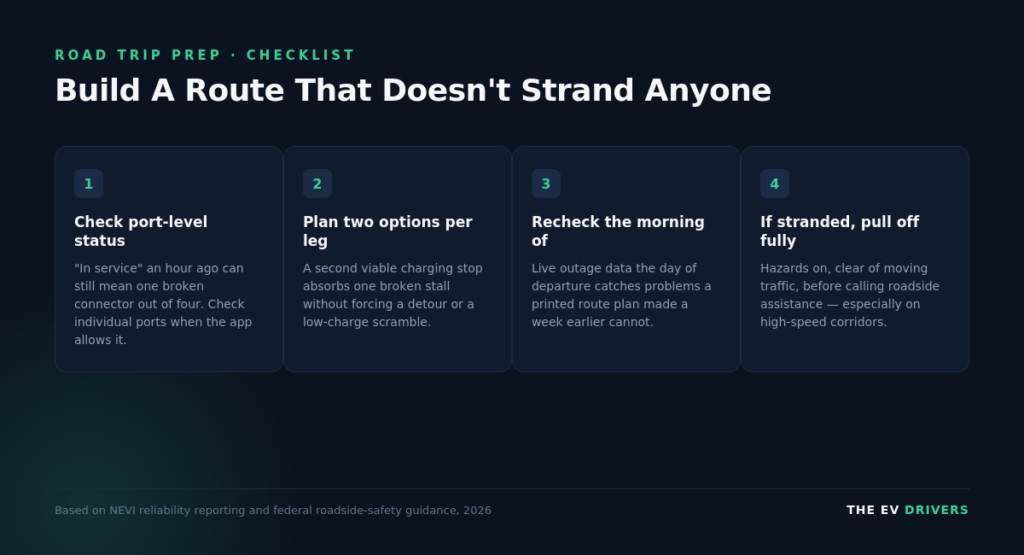
Technician’s Note: Before a long drive, pull up live status for the two or three chargers planned along the route, not just the destination. A station showing “in service” an hour ago can still have one broken connector out of four, so check individual port status when the app allows it.
Checking a network’s app for real-time outage reports the morning of departure catches problems a printed route plan cannot. Crowdsourced charger apps that show recent driver check-ins add a second layer of confirmation beyond official network status.
Why Some Networks Look Better On Paper Than On The Road
Network-published uptime figures sometimes describe next-generation hardware performance rather than the full fleet of installed stations. Older stations installed years ago drag a network’s real average down, even when the company’s newest equipment performs well above 95%. That distinction matters when comparing a marketing claim to the experience at a specific, older stall along a specific route.
This is not a reason to distrust every network claim outright. It is a reason to check port-level, recent data instead of a single network-wide percentage pulled from a press release.
Building A Route That Does Not Strand Anyone
Federal safety guidance for any breakdown situation applies equally to a dead battery on the shoulder. Pull as far off the traveled lane as possible, engage hazard lights, and stay clear of moving traffic while waiting for help. That step matters most on high-speed corridors where a stalled EV sits in a live lane longer than most drivers expect.
Planning two viable charging options per leg, not one, absorbs a single broken stall without forcing a detour. Checking live uptime data the morning of departure, not the week before, catches outages that a static map cannot show.
Common Questions About Charging Reliability
What uptime percentage should a charger actually hit before it is considered dependable? Federally funded NEVI stations must maintain 97% uptime annually. Independent monitoring shows the broader public DC fast-charging network averaging in the low-to-mid 90s, so route planning should treat that gap as a real margin.
Do fast network-wide reliability numbers reflect every individual charging stall? Not always. A network’s published average can reflect newer hardware performance rather than its full installed base, including older stations. Checking port-level status for the specific stalls on a route gives a more accurate picture.
What should a driver do if a planned charging stop is broken on arrival? Check the app for the next-closest working stall immediately rather than waiting at a dead unit. If stranded roadside with low charge, pull fully off the travel lane, use hazard lights, and contact roadside assistance.